Wriai vs ProRankTracker: AI SEO Automation vs Rank Tracking
Wriai vs ProRankTracker is a comparison between two different kinds of SEO software: Wriai is an autonomous platform that executes a broader content and optimization workflow, while ProRankTracker is dedicated to monitoring keyword positions. Choose based on the job you need done. If you mainly need rank data, a tracker is the more direct fit; if you need connected workflows from opportunity discovery through publishing and content maintenance, an automation platform addresses more of the process.
What Wriai and ProRankTracker do—and why the difference matters
Wriai and ProRankTracker are not interchangeable tools. One is built to automate multiple SEO tasks; the other focuses on tracking rankings so teams can observe visibility changes and assess performance.
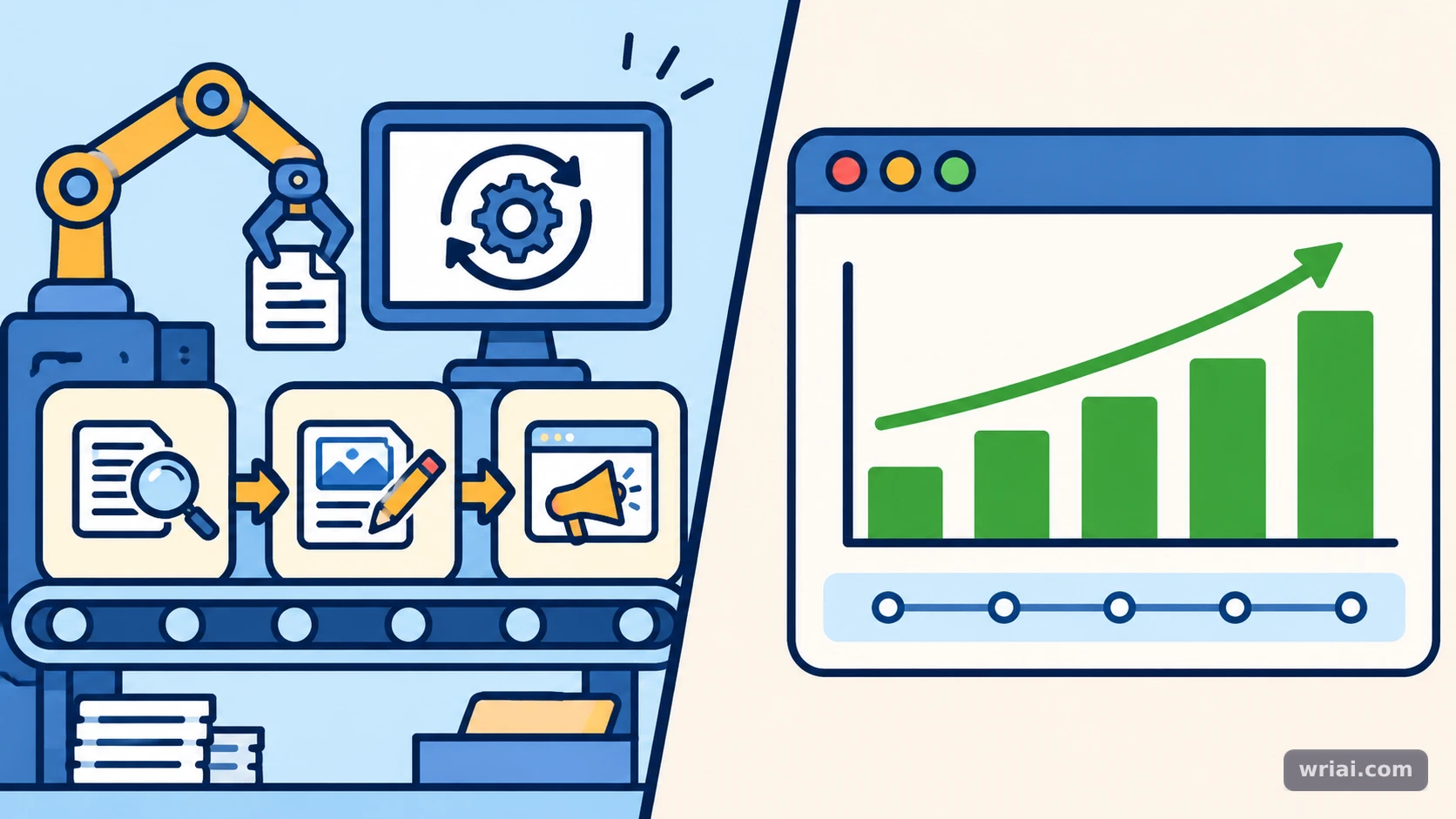 Wriai vs ProRankTracker: AI SEO Automation vs Rank Tracking - Visual comparison of Wriai automation workflow versus ProRankTracker monitoring dashboard
Wriai: automation across the content lifecycle
Wriai is an autonomous AI SEO automation and content lifecycle management platform. Its workflow can use Search Console data to identify keywords ranking in positions 4–20, create researched articles, publish them to connected content management systems, support indexing, add contextual internal links, distribute content socially, and monitor pages for decay.
That breadth matters when a team has more work than it can consistently execute. A site with promising pages, an editorial backlog, and limited publishing capacity may need help moving from a ranking opportunity to a published and maintained page—not simply another report about keyword positions.
Wriai also includes built-in rank tracking and Search Console integration as part of its broader suite. Its other capabilities include an AI Market Radar for competitor analysis, a keyword cannibalization checker, AI search tracking, and WooCommerce product SEO workflows designed to update product pages without changing SKU, price, or stock data.
ProRankTracker: focused visibility monitoring
ProRankTracker is a dedicated rank tracking tool. Its central role is to monitor keyword positions in search engines, giving users a way to follow rankings rather than automate the wider content lifecycle.
That focus can be useful if a team already has established processes for research, writing, publishing, and optimization. A specialist tracker can fit into a reporting workflow where the main question is, “How are our tracked keywords moving?” For a related look at agency reporting, see Wriai vs AgencyAnalytics. It should not, however, be treated as an autonomous content production or publishing system based on the facts available here.
The distinction is practical: tracking describes what is happening in search results; automation helps execute work in response. Teams may need one, the other, or both kinds of capability.
The choice is about workflow coverage, not a feature-count contest
A rank tracker is most relevant when the bottleneck is measurement, as explored in this Wriai vs AccuRanker comparison. An automation platform becomes relevant when the bottleneck is carrying out repetitive work across research, content, publishing, internal linking, and refreshes.
For example, a marketing team that already has writers and a CMS process may prioritize consistent position reporting. A small team that finds opportunities but struggles to publish and maintain content may value a connected workflow more. Neither choice guarantees higher rankings: outcomes still depend on content quality, site conditions, competition, and execution.
For context on how an agent-based platform connects optimization with publishing, see Wriai’s explanation of AI SEO workflow automation.
Compare the tools by the work you need to complete
The most useful comparison is task-based: identify what each platform is designed to do, then check whether it addresses your team’s actual bottleneck. The table separates rank monitoring from broader SEO execution without assuming that the two tools have identical capabilities.
Capability comparison
| SEO task or requirement | Wriai | ProRankTracker |
|---|---|---|
| Primary role | Autonomous SEO automation and content lifecycle management | Dedicated keyword rank tracking |
| Keyword position monitoring | Built-in rank tracking; supports Google Top 30 tracking by country and device | Monitoring keyword positions in search engines is its stated focus |
| Search Console opportunities | Search Console Radar identifies keywords ranking in positions 4–20 | Not established here as a core capability |
| Content research and creation | Generates researched, long-form articles, including 2,500+ word content | Not established here as a core capability |
| CMS publishing | Direct publishing integrations include WordPress, Shopify, Ghost, and custom platforms | Not established here as a core capability |
| Internal linking | AI-powered contextual linking, including bidirectional linking | Not established here as a core capability |
| Indexing workflow | Supports rapid discovery using the Google Indexing API | Not established here as a core capability |
| Performance maintenance | Content Decay Sentinel monitors performance and can trigger one-click refreshes | Ranking data can inform monitoring; automated refresh execution is not established here |
| AI search visibility | Tracks whether Google AI Overviews, Gemini, ChatGPT, or Perplexity mention a brand | Not established here as a core capability |
| Best-fit starting point | Teams seeking to connect opportunity discovery, execution, and maintenance | Teams whose primary requirement is rank monitoring |
“Not established here” does not mean a capability is definitively absent from ProRankTracker. It means this comparison does not assume features beyond its stated role as a dedicated rank tracking tool. Verify current product documentation before making a procurement decision.
What the comparison means for daily work
If your weekly SEO routine is largely about checking position changes, segmenting keyword performance, and communicating results, a rank tracking tool may cover the central need. If the routine also includes selecting opportunities, commissioning or generating content, publishing it, linking it internally, and revisiting declining pages, compare platforms on how much of that workflow they can execute.
Wriai supports Google Top 30 tracking by country and device, alongside broader automation. That can be useful when location and device context matter to your analysis. Its AI Search Tracking also addresses a different question from conventional ranking: whether named AI search experiences mention a brand.
How to assess the fit before choosing
Use a short requirements checklist rather than comparing feature names in isolation:
- Measurement: Do you need keyword positions, country and device segmentation, or AI search mentions?
- Execution: Do you need software to create, publish, link, distribute, or refresh content?
- Existing process: Which steps are already handled reliably by people or other tools?
- Control: Which tasks should remain under human review, and which can be automated?
- Integration: Does the platform connect to your CMS and relevant data sources?
A tool is valuable when its outputs change what the team can accomplish. If ranking reports are not followed by action, adding more reporting may not address the bottleneck. If content is produced but not measured or refreshed, automation without a measurement routine may leave important questions unanswered.
How to use rank tracking and automation in a practical SEO workflow
A practical workflow starts with measurement and ends with review. Rank data can help identify where attention is warranted; automation can support the work that follows, while human review keeps changes aligned with site goals and content standards.
Step 1: establish what you are tracking
Choose the keywords and pages that matter to a real business or audience goal. Record the target country and device context where relevant, because ranking observations can vary with those settings. Avoid treating a single keyword movement as a verdict on an entire page or strategy.
With a tracker, define a consistent monitoring routine and use it to spot movement worth investigating. With Wriai, Google Top 30 tracking and Search Console integration can provide visibility into positions and search opportunities within a broader workflow.
Step 2: investigate opportunities before creating content
Wriai’s Search Console Radar identifies keywords ranking in positions 4–20. These are potential opportunities to investigate, not automatic proof that a page should be rewritten or that a new article is required.
For each candidate, check the relevant page, its search intent, and whether another page on the site already serves the same purpose. A keyword cannibalization check can help identify overlap. A position in the 4–20 range is a useful starting signal, but the best response may be improving an existing page rather than publishing a competing one.
Step 3: create, review, and publish with safeguards
If a content gap is confirmed, Wriai can create researched long-form content and publish through integrations for WordPress, Shopify, Ghost, and custom platforms. Its workflow also supports internal linking, indexing, social distribution, and scheduled content planning.
Automation reduces repetitive execution, but it does not remove the need to check whether a page is accurate, useful, and appropriate for the site. Review claims, sources, search intent, internal links, and CMS rendering before relying on a published page. Teams should also ensure their publishing permissions and review expectations are clear.
Step 4: monitor outcomes and maintain the page
After publication or an update, continue monitoring the target page and relevant queries. Wriai’s Content Decay Sentinel is designed to monitor performance and trigger one-click refreshes when content declines. Use those signals to investigate what changed before making edits; not every dip calls for a rewrite.
A tracker-led process can still support a disciplined review cycle: observe a change, investigate the page and search context, decide on an action, and measure again. The key is to connect observations to decisions rather than reacting to every short-term fluctuation.
Expert tips, common mistakes, and an example workflow
The strongest comparison avoids treating rankings as a complete measure of SEO or automation as a substitute for judgment. Use tools to make work more consistent, but define the decisions and quality checks that sit around them.
Avoid common measurement and automation mistakes
Mistake: comparing unlike data. A position report is meaningful only when the keyword, location, device, and measurement context are understood. Keep comparisons consistent and investigate before attributing a change to a specific content edit.
Mistake: creating a new page for every opportunity. A keyword ranking in positions 4–20 may point to an update opportunity for an existing page. Check for overlap and intent before producing another URL; otherwise, content may compete internally.
Mistake: assuming publishing equals optimization. Publishing is one step, not the finish line. Internal links, indexing, distribution, performance monitoring, and future updates can all matter to a page’s lifecycle.
Mistake: automating without review criteria. Decide what requires human approval, especially factual claims, product details, and pages with a direct effect on customers. For WooCommerce, Wriai’s product SEO workspace is specified to update product pages without altering SKU, price, or stock data; teams should still confirm the result fits their catalog workflow.
A realistic example: a small team with an editorial backlog
Imagine a SaaS team that already tracks priority search terms but has several useful pages that are not attracting the visibility it expects. A rank tracker can help the team follow keyword positions and identify changes. It does not, by itself, complete the next steps of assessing content gaps, producing a page, publishing it, and maintaining it.
An automation workflow could use Search Console data to surface queries in positions 4–20, prompt the team to inspect intent and existing coverage, and support content creation and publication when a genuine gap exists. The team can then monitor performance and review potential decay. This division of work is useful: software handles repeatable steps, while people decide whether the content deserves to exist and whether it meets quality standards.
Treat AI search visibility as a separate measurement question
Traditional keyword rankings and mentions in AI search experiences are related but not identical signals. Wriai’s AI Search Tracking is intended to monitor whether Google AI Overviews, Gemini, ChatGPT, or Perplexity mention a specific brand. That can help teams ask whether their brand appears in those experiences, alongside conventional ranking monitoring.
Do not interpret a mention as proof of traffic, sentiment, or business impact unless you have separate evidence for those outcomes. Likewise, a lack of a tracked mention does not explain why it is absent. Treat AI visibility as an additional observation to investigate, not a replacement for search performance analysis.
Which tool fits your team and its current bottleneck?
The right choice depends on what is missing from your process today. A focused tracker suits a measurement-led requirement; a broader automation platform is relevant when the team needs help executing multiple connected SEO tasks.
Choose a rank tracker when measurement is the priority
A dedicated rank tracking tool is a sensible starting point when your main questions concern keyword position changes and reporting. This may fit an agency that already has established research and content teams, or a website owner who needs a clearer view of tracked search visibility.
Before adopting any tracker, define how rankings will be used: which terms are important, who reviews movement, and what action follows a meaningful change. Without that operating routine, reporting can accumulate without improving decisions.
Consider automation when execution is the bottleneck
Wriai is more relevant when your team needs to connect opportunity discovery with content creation, CMS publishing, internal linking, indexing, social distribution, content planning, and refreshes. Its direct integrations include WordPress, Shopify, and Ghost, and it also connects with Bing Webmaster Tools.
That range may be useful for content marketers, website owners, SaaS businesses, and agencies managing recurring work across sites. Teams should map their current process first: if a step is already reliable and controlled elsewhere, automating it may add little. If work repeatedly stalls between identifying an opportunity and maintaining the published page, end-to-end execution becomes more relevant.
Decide whether you need one tool or complementary roles
Some teams need only rank monitoring; others need a platform that executes a wider workflow. A team may also use a dedicated tracker alongside an automation platform if it has a specific measurement requirement and wants separate tools for distinct jobs. Wriai already includes built-in rank tracking, so assess whether that meets your needs before adding another system.
A useful decision rule is to start with the bottleneck, not the brand: choose tracking for visibility measurement, automation for workflow execution, and a combined setup only when each tool adds a distinct capability. For additional context about Wriai’s role as an autonomous platform, its About Us page describes the broader product positioning.
FAQ
Is Wriai a replacement for ProRankTracker?
Not necessarily. ProRankTracker is a dedicated rank tracking tool, while Wriai is an autonomous SEO automation and content lifecycle platform that also includes rank tracking. If your requirement is narrowly focused on monitoring positions, compare specialist tracking needs directly. If you need connected work such as opportunity discovery, content production, publishing, linking, and performance maintenance, assess whether Wriai’s broader workflow fits. The right choice depends on the features and reporting your team actually requires.
Can Wriai track keyword rankings?
Yes. Wriai includes built-in rank tracking and supports tracking keywords in Google’s Top 30 by country and device. It also integrates with Google Search Console, whose data supports its Search Console Radar for identifying keywords ranking in positions 4–20. These capabilities sit within a wider automation suite, rather than defining the platform’s entire purpose. Teams should still select relevant keywords and interpret ranking changes in context instead of treating positions as a complete measure of SEO performance.
Does Wriai only generate AI articles?
No. Content generation is one part of Wriai’s broader content lifecycle workflow. Its capabilities also include opportunity discovery, direct publishing to supported CMS platforms, internal linking, indexing support, social distribution, content planning, performance monitoring, and refresh workflows. The practical distinction is that it is designed to help execute connected SEO tasks, not simply draft text. Human review remains important for accuracy, usefulness, search intent, and site-specific requirements before and after publication.
Can I use a rank tracker and an automation platform together?
Yes, if the tools serve distinct needs and the combined setup fits your workflow. A team might use a dedicated tracker for a specific monitoring or reporting requirement while using an automation platform for research, publishing, linking, and maintenance. However, Wriai already includes rank tracking, so first check whether its built-in capability covers your use case. Avoid duplicating systems unless the additional tool provides a clear operational benefit, and define which platform is the source of truth for each metric.
Alex Vance
Head of AI SEO & Autonomous Growth Systems
Specialist with 9+ years of experience in algorithmic search engine optimization, semantic knowledge graphs, and large-scale LLM automation.