Wriai vs AccuRanker: AI SEO Agent vs. Rank Tracking Platform
Like the Wriai vs ProRankTracker comparison, this comparison covers two different kinds of SEO software: Wriai automates content and site-management workflows, while AccuRanker specializes in monitoring search visibility. Choose based on the job you need done. If you need a system to find opportunities, create and publish content, and help manage its lifecycle, consider an automation platform. If you need fast, detailed keyword-position data and reporting, a rank tracker is the closer fit.
What Wriai and AccuRanker do—and why the difference matters
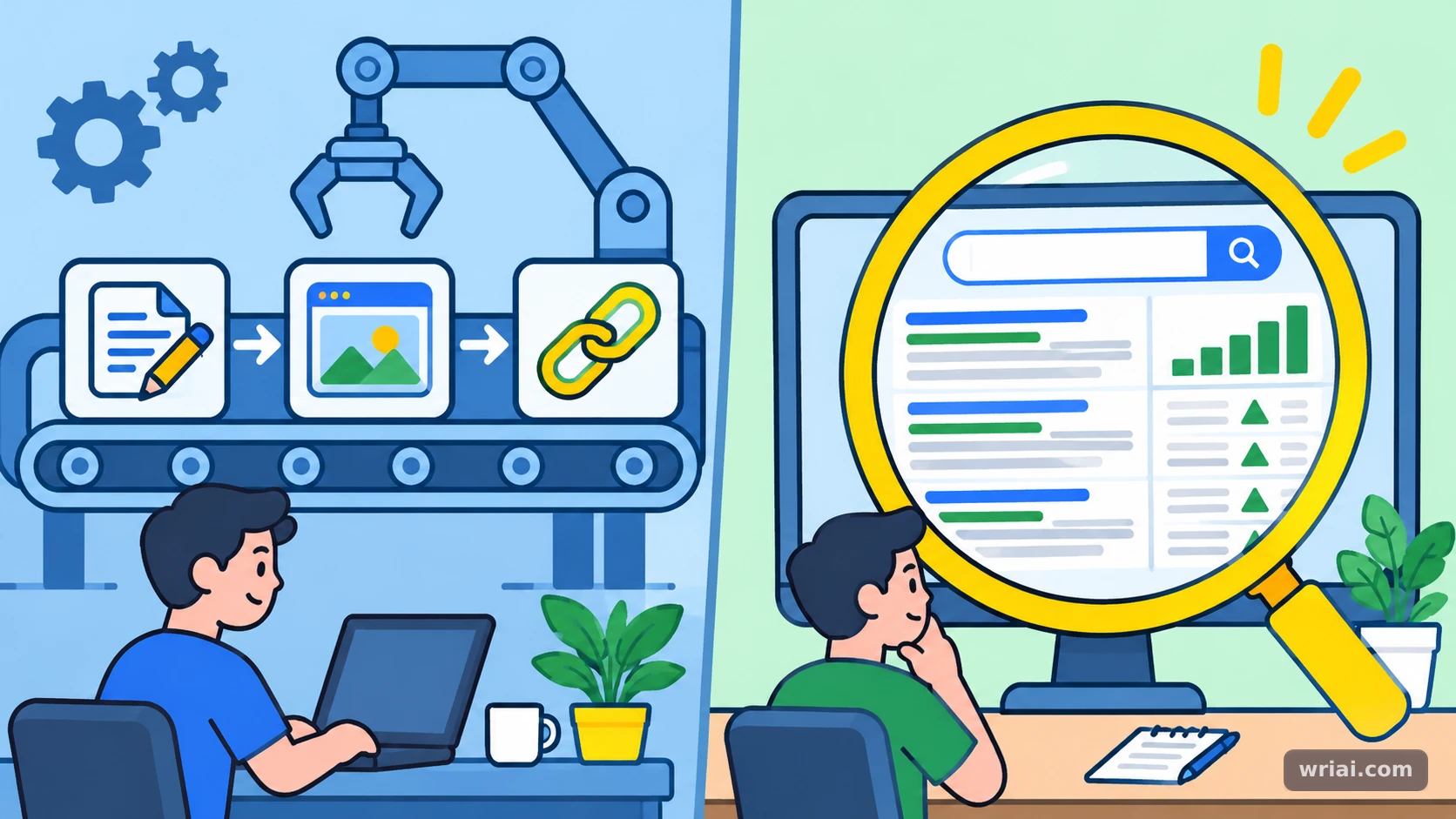
Wriai is built to execute connected SEO tasks, while AccuRanker is built to measure search performance. They may both support organic growth, but they address different operational needs rather than offering interchangeable versions of the same tool.
 Wriai vs AccuRanker: AI SEO Agent vs. Rank Tracking Platform - What Wriai and AccuRanker do—and why the difference matters
An automation engine versus a measurement tool
Wriai’s role is to help move work through a content and SEO lifecycle. Its closed-loop workflow covers opportunity discovery, content generation, publishing, indexing, internal linking, link exchange, social distribution, performance monitoring, content planning, and image generation. The practical distinction is that the platform is designed to perform SEO tasks, not just present data or recommendations.
AccuRanker’s primary role is rank tracking. It provides keyword-position updates and visibility reporting, alongside competitor analysis, SERP analysis, and forecasting. Its AI-related capability, AccuLLM, monitors brand performance in AI search environments such as ChatGPT, Perplexity, AI Overviews, and AI Mode. That is analysis and reporting, not automated article production or CMS publishing.
This distinction matters when evaluating a tool against a team’s actual bottleneck. A team with a content backlog may need help executing work; a team that already produces content but needs dependable visibility data may need stronger rank monitoring.
What each platform means for an SEO team
A rank tracker such as the one compared in Wriai vs Raven Tools helps answer questions such as: Which keywords improved? Where did visibility fall? How do competitors appear in the SERPs? That information can shape decisions, but it does not by itself write or update a page, publish it to a CMS, or refresh declining content.
An automation platform can connect some of those operational steps. Wriai scans Google Search Console for keywords ranking in positions #4–20, where pages may have room to improve. It can then support content creation and management workflows, including publishing through connected CMS platforms such as WordPress, Shopify, and Ghost.
For a practical explanation of how automated SEO and publishing tasks fit together, see this guide to AI SEO agent workflows. The key evaluation question is not simply “Which has more features?” but “Which part of our process is currently slow, manual, or poorly measured?”
The role of AI in each product
AI is used differently in these products. Wriai applies AI to operational work such as generating long-form content, creating images, supporting internal linking, and managing content workflows. Its content generation can produce articles of 2,500 words or more with entity coverage; that capability does not remove the need for editorial review, fact-checking, or subject-matter judgment.
AccuRanker applies AI through AccuLLM to monitor and report brand performance across AI search experiences. That can help teams understand whether their brand appears in those environments. It does not mean the platform is an AI content-production or publishing system.
For SEO and GEO teams, the distinction is useful: one category can help execute changes; the other can help assess visibility. Neither replaces a clear strategy, accurate information, or human accountability for published claims.
Wriai vs AccuRanker: a practical capability comparison
The comparison below focuses on function and workflow rather than price. It can help teams identify which platform is more directly aligned with their immediate requirement and where complementary tools may be needed.
| Evaluation area | Wriai | AccuRanker |
|---|---|---|
| Primary purpose | Automates SEO and content lifecycle tasks | Tracks and reports search visibility |
| Opportunity discovery | Scans Google Search Console for keywords in positions #4–20 | Provides rank, competitor, and SERP analysis |
| Content creation | Generates long-form content with entity coverage | Not positioned as an automated content-production platform |
| Publishing | Connects with CMS platforms including WordPress, Shopify, and Ghost | Feeds rank data into external reporting workflows |
| Rank monitoring | Monitors content performance as part of a broader workflow | Core focus: keyword positions and visibility reporting |
| AI search | Supports content and SEO execution | AccuLLM monitors brand visibility across AI search experiences |
| Indexing | Workflow includes Google Indexing API submission; average Googlebot discovery is under 24 hours | Not identified as an indexing automation platform |
| Content maintenance | Includes content-decay monitoring and refresh workflows | Reports visibility changes that can inform maintenance decisions |
| Best-fit need | Reducing manual execution across connected SEO tasks | High-volume, fast keyword tracking and reporting |
| Typical users | Marketers, site owners, SEO teams, SaaS businesses, and agencies | Agencies, enterprises, and consultants needing reliable tracking |
How to interpret the table
The table describes each platform’s stated focus, not a claim that one product covers every SEO requirement. For example, Wriai’s performance monitoring does not make it a dedicated rank tracker equivalent to AccuRanker. Likewise, AccuRanker’s AI search monitoring does not make it a content lifecycle automation platform.
When comparing options, separate execution capabilities from measurement capabilities. Execution includes research, creating or updating pages, publishing, linking, and distributing content. Measurement includes tracking keyword positions, comparing competitors, and reporting changes in visibility. Teams often need both kinds of capability, whether through one connected system or a broader tool stack.
Where the workflows overlap—and where they do not
There is overlap in the overall goal: improving and understanding organic search performance. Both products can support decisions about SEO work, but their direct contributions differ. Wriai’s workflow is oriented toward taking action on content and site management; AccuRanker’s is oriented toward producing search visibility data.
The products should not be assumed to connect directly or to replace one another. AccuRanker integrates with external tools to feed rank data into wider reporting workflows. Wriai integrates with selected CMS platforms for publishing and updating content. Before purchase or implementation, verify that each product supports the specific integrations and reporting destinations your team depends on.
How to use the right tool in a real SEO workflow
Start with the work you need to accomplish, then map each step to a tool. A useful evaluation is to trace one real keyword opportunity from discovery through publication and subsequent measurement.
Step 1: Define the bottleneck and establish a baseline
Write down the task that is currently limiting progress. Is the team short on accurate daily position data? Does it know which pages are underperforming but lack capacity to update them? Are opportunities visible in Search Console but not being turned into published, maintained content?
For a content opportunity, record the target query, the existing page (if there is one), its current Search Console position, and the intended reader need. Wriai’s stated opportunity scan focuses on keywords in positions #4–20, which can help surface ranking gaps for review. Treat those findings as candidates, not automatic proof that a page should be created or rewritten.
For a reporting need, define the keywords, markets, competitors, update frequency, and stakeholder reports that matter. Those requirements help determine whether a specialized tracker such as AccuRanker fits the measurement task.
Step 2: Choose the workflow that matches the need
If the challenge is operational capacity, assess how an automation workflow handles research, content generation, CMS publishing, linking, indexing, distribution, and content decay. Wriai describes these as parts of a closed-loop process. Confirm how much review your team retains at each step and who is accountable for approving content.
If the challenge is visibility measurement, assess rank tracking, competitor comparisons, SERP analysis, reporting, and the usefulness of AI-search monitoring. AccuRanker’s focus is fast, accurate position data and visibility reporting for agencies, enterprises, and consultants. Ensure that the reports answer questions people actually use to make decisions.
Avoid choosing based on a feature list alone. A feature is useful when it fits a real process, has an owner, and leads to a decision or action.
Step 3: Run a controlled test and check the output
Use a small, representative group of pages or keywords rather than changing a whole site at once. For automation, review research quality, factual accuracy, entity coverage, on-page relevance, internal links, CMS formatting, and the final published page. Confirm that a human can pause or correct a workflow where necessary.
For rank tracking, confirm that the selected keyword set reflects business priorities and that reports make changes interpretable. A position fluctuation is a signal to investigate, not necessarily evidence that a page needs an immediate rewrite. Consider the SERP context, competing pages, and whether the result matches the user’s intent.
Keep a record of the starting point, actions taken, and subsequent observations. This makes it easier to distinguish tool performance from seasonality, site changes, or other factors.
Step 4: Connect action and measurement
A complete operating process needs both follow-through and feedback. A team might use Search Console data to identify a page with improvement potential, review and publish an update, then use rank and visibility reporting to assess what happened. The specific tool stack depends on the team’s integrations and reporting requirements.
Do not treat indexing as a guarantee of ranking. Wriai’s stated average Googlebot discovery time is under 24 hours through the Google Indexing API, but discovery and indexing are distinct from ranking outcomes. Check whether pages are discoverable and indexed, then evaluate performance over an appropriate period rather than interpreting one early position as a final result.
Common mistakes, practical tips, and examples
The best comparison is grounded in the work a team actually performs. Misclassifying a platform as a substitute for a different tool category can create gaps in either execution or reporting.
Mistakes to avoid when comparing the products
Comparing an automation platform with a rank tracker as if they were direct substitutes is the most common mistake. One emphasizes doing SEO work; the other emphasizes measuring positions and visibility. A better comparison asks which tasks each can own and what remains manual.
Assuming AI-generated content is ready to publish without review is another risk. Long-form generation and entity coverage can support production, but they do not guarantee accuracy, originality, expertise, or alignment with a specific audience. Editors should verify claims, sources, intent, and the value of the finished page.
Treating indexing speed as a ranking promise creates unrealistic expectations. Faster discovery can shorten the wait before a crawler finds a URL; it cannot guarantee rankings, traffic, or conversions.
Finally, do not make reporting more elaborate than the decisions it supports. A rank dashboard is valuable when it informs action, and automation is valuable when it produces work that meets quality standards.
Example: a small SaaS team with a content backlog
Imagine a SaaS team has useful product knowledge and a list of organic search opportunities, but publishing is slow. It finds relevant queries in Search Console, yet writers and editors cannot keep up with briefs, article drafts, CMS uploads, and refreshes.
In that situation, an automation platform may address the operational bottleneck more directly. The team could use opportunity discovery to shortlist candidate topics, generate a draft for expert review, publish through its supported CMS, and monitor the page’s lifecycle. It should still decide whether each topic serves the audience and validate every product claim.
If the same team already has a functioning editorial process but cannot reliably report keyword movements across many tracked terms, a rank tracker may be more immediately useful. The choice follows the constraint, not the organization’s size.
Example: an agency reporting on many client sites
An agency handling multiple clients may need high-volume keyword tracking, competitor context, and repeatable visibility reporting. AccuRanker’s stated focus on fast, accurate rank data for agencies and enterprises makes it a natural candidate to assess for that requirement.
The agency may also have clients who struggle to convert insights into content work. That is a separate need: automated research, content production, publishing, and maintenance. In that case, a broader tool stack could combine rank reporting with a workflow platform, provided the integrations, permissions, and review controls fit the agency’s process.
Alex Vance’s practical evaluation principle is to map tools to handoffs: identify where data is collected, who interprets it, who approves the work, and how the result is checked. Gaps between those steps often matter more than a long feature list.
Which option fits your team?
The right choice depends on whether your main constraint is execution, measurement, or both. Compare the tools against your team’s workflow, technical setup, and accountability requirements rather than treating either category as a universal SEO solution.
Choose based on the work you need done
Consider Wriai when the priority is connecting SEO activities such as opportunity discovery, content generation, CMS publishing, internal linking, indexing, distribution, and content refresh. Its potential value is greatest when manual handoffs across those tasks are slowing a team down and when there is a review process for AI-assisted work.
Consider AccuRanker when the priority is keyword-position monitoring, visibility reporting, competitor analysis, SERP analysis, forecasting, or AI search brand monitoring through AccuLLM. Its specialized focus is relevant to teams that need dependable tracking data at scale.
These are not mutually exclusive needs. A content team may need to execute work and measure the outcome; a reporting team may need to deliver data while another team acts on it. The question is whether your existing tools already cover one side adequately.
Match the choice to your team’s operating model
Website owners and small content teams should identify whether time is being lost to production and upkeep or to a lack of clear performance data. If execution is the bottleneck, prioritize workflow support and editorial control. If measurement is the bottleneck, prioritize tracking coverage and useful reporting.
Agencies and consultants should assess client volume, report requirements, keyword scale, and the amount of content work they manage. A tracking-first workflow and a content-automation workflow solve different parts of agency delivery. Confirm that the product fits your client permissions, integrations, and review standards.
SaaS and enterprise teams should consider data ownership, CMS compatibility, reporting destinations, approval steps, and how AI search visibility will be evaluated. Use a pilot to validate actual output in your environment rather than assuming advertised capabilities match every internal process.
A simple decision framework
Use these questions to narrow the choice:
- Do you need a platform to help produce and manage SEO work, or primarily to monitor and report search visibility?
- Is your current bottleneck research and publishing, or collecting and interpreting ranking data?
- Which systems must the tool connect to—your CMS, reporting stack, or both?
- Who will review AI-assisted content and act on rank changes?
- What evidence will tell you that the workflow is useful?
If the answers point to both execution and measurement, plan for complementary capabilities rather than expecting one product to perform every role. Wriai’s overview of its autonomous SEO platform describes its broader lifecycle focus; AccuRanker’s product positioning is centered on rank tracking and visibility. Validate current capabilities and integrations directly before committing to a workflow.
FAQ
Is Wriai a direct alternative to AccuRanker?
Not as a like-for-like replacement. Wriai is an autonomous SEO and content lifecycle platform designed to help execute tasks such as opportunity discovery, content creation, publishing, linking, and content maintenance. AccuRanker is a specialized rank tracking platform focused on keyword positions and visibility reporting. A team should compare them against its primary need: operational execution, performance measurement, or both.
Does AccuRanker create and publish SEO articles?
AccuRanker’s stated focus is rank tracking, competitor and SERP analysis, forecasting, and visibility reporting. It is not positioned as a platform for automated article production or CMS publishing. Teams that need those capabilities should evaluate a content-production and publishing workflow separately, while checking that each tool supports the integrations and processes they require.
Can Wriai replace a dedicated rank tracker?
Wriai monitors content performance as part of its wider SEO workflow, but its primary role is automation rather than specialized, high-volume rank tracking. If daily keyword positions, competitor comparisons, and detailed visibility reporting are central requirements, assess a dedicated tracker such as AccuRanker. Some teams may use automation and tracking tools together to connect content work with measurement.
Does faster indexing guarantee higher rankings?
No. Faster URL discovery is not a promise of indexing, ranking, traffic, or conversions. Wriai reports average Googlebot discovery in under 24 hours through the Google Indexing API, but discovery and ranking are different outcomes. A page still needs to be useful, accessible, relevant to search intent, and competitive. Check indexing status and performance separately, and use ranking changes as evidence to investigate rather than as a guaranteed result.
Alex Vance
Head of AI SEO & Autonomous Growth Systems
Specialist with 9+ years of experience in algorithmic search engine optimization, semantic knowledge graphs, and large-scale LLM automation.